Support isn’t a job title: Why workplace mental health needs everyone
Mental health support cannot sit with HR, Mental Health First Aiders and EAPs alone. They matter, but they are not in every conversation, every van, every team meeting or every quiet moment when someone starts to fade.
WORKPLACE MENTAL HEALTHPEER SUPPORTLEADERSHIP & CULTURE
The gap I keep seeing
Most workplaces now have some form of mental health support in place.
A policy.
An EAP.
A wellbeing page.
A Mental Health First Aider.
A manager people are told they can speak to.
That all matters.
But there is still a gap.
It is the gap between support existing and people actually feeling safe enough to use it.
This is the invisible barrier we need to break through.
I have seen this from both sides. As someone who struggled silently and as someone who has worked in organisations where good people kept pushing through until they had nothing left.
Most people do not suddenly fall apart in public.
They go quiet first.
They withdraw.
They stop contributing.
They stop joking.
They start making mistakes.
They look fine from a distance, but something has changed.
And too often, everyone notices too late.
Why traditional employee wellbeing programmes aren't working
Formal support has an important place.
HR matters.
Managers matter.
Mental Health First Aiders matter.
EAPs and external support services matter.
But not everyone feels ready to use them.
Some people worry about confidentiality.
Some worry about being judged.
Some do not want their manager to know.
Some have had poor experiences before.
Some do not think their situation is “bad enough”.
Some simply do not know where to start.
So they do what many of us have done.
They keep going.
They say, “I’m fine.”
They carry the pressure into work, through work and home again at the end of the day.
Low use of support does not always mean low need. Sometimes it means low trust.
Addressing the bystander effect in the workplace
There is another problem that does not get talked about enough.
When support is attached only to specific job titles, everyone else can step back.
HR assumes managers are watching out.
Managers assume Mental Health First Aiders are handling it.
Mental Health First Aiders wait for people to come forward.
Colleagues assume it is not their place.
The person struggling assumes nobody has noticed.
That is how people slip through the cracks.
Not because nobody cares. Because nobody is quite sure who should act.
That is the workplace bystander effect. And it is dangerous.
The power of informal peer support networks
When people do open up, they often start with someone they already trust.
The person they sit next to.
The colleague they message every day.
The teammate who notices they are quieter than usual.
The person who asks twice instead of accepting “I’m fine” as the final answer.
Real support often starts with simple human moments:
“You seemed a bit quiet earlier. Everything alright?”
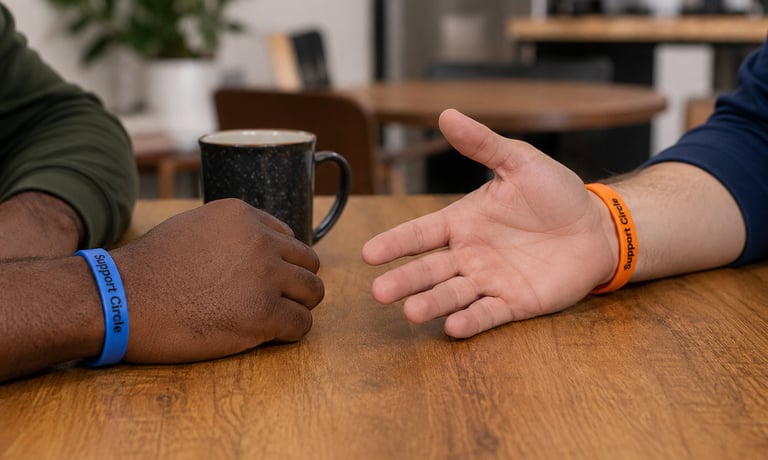
“That meeting looked rough. Fancy a coffee?”
“You don’t seem yourself today. I’m here if you need to talk.”
These are not clinical interventions. They are not therapy. They are not about fixing someone.
They are about noticing, listening and helping someone feel less alone.
That sounds simple, but in a busy workplace it rarely happens by accident. It has to be made normal.
Setting safe boundaries for peer support at work
This is where organisations need to be careful.
The answer is not to turn everyone into a counsellor, therapist or crisis responder. That would be unsafe, unrealistic and unfair.
People need boundaries.
They need to understand that their role is not to diagnose, rescue, fix or carry someone else’s problems. Their role is to notice, check in, listen and signpost when needed.
That is very different.
You do not need a qualification to show empathy. You do not need an HR title to ask someone how they are.
But you do need enough confidence and clarity to do it safely.
Introducing Support Circle: Shifting to proactive workplace mental health
I know what it looks like when a system pushes people past their human limits because I lived through complete burnout myself. That is why I created Support Circle.
Support Circle does not replace HR, Mental Health First Aid, EAPs, managers or external services. It is proactive support that makes them easier to reach.
It helps create more trusted touchpoints across the workforce, so people are more likely to speak before they reach crisis point. It gives colleagues a simple, safe structure for checking in, listening and guiding someone towards the right support.
Not as experts. As people.
Because mental health at work cannot just be the responsibility of a few named individuals. It has to become part of how people look out for each other every day.
The hidden cost of poor workplace mental health culture
This is not just a “nice thing to do”. When people struggle silently, the business feels it.
Absence increases.
Presenteeism rises.
Trust drops.
Managers spend more time firefighting.
Teams disconnect.
Good people leave.
Performance suffers.
The cost does not always appear immediately, but it builds. A poor culture rarely collapses overnight. It erodes slowly.
Support Circle helps organisations move from reactive support to earlier, everyday prevention:
More people noticed earlier.
More conversations before crisis.
Better use of existing support.
Clearer boundaries.
Less silence.
Stronger culture.
That is where the real value sits. Not in another awareness poster. In changing what people do on a normal Tuesday afternoon when someone clearly is not OK.
A Healthier Workplace Starts Earlier
Formal systems are the safety net. Everyday culture is the floor.
If the floor is cracked, people fall before the safety net ever gets used. That is the shift workplaces need to make.
Support should not only appear when someone is already in crisis, signed off work or at breaking point. It needs to be visible earlier. Safer earlier. Human earlier.
Because most people do not break suddenly. They fade quietly first.
And if we want healthier workplaces, we need more people who know how to notice, listen and act within clear boundaries.
Not everyone needs to be an expert. But everyone can play a part.
Bring Support Circle to your organisation
Want to make support safer, earlier and easier to access?
If you’re struggling
Life First Then Work isn’t a crisis service but if you need urgent help, please don’t suffer in silence.
Take action.
Immediate threat to life
🚨 Call 999 or go to your local Accident and Emergency (A&E) department if:
Someone has seriously injured themselves or taken an overdose.
You do not feel you or someone else can be kept safe.
There is a risk of physical violence or harm to others.
The emergency services can ensure immediate safety and arrange a mental health assessment.
Urgent help (not immediate threat)
📞 Call 111 and select the mental health option for 24/7 urgent mental health help. You may be able to speak to a trained mental health professional over the phone.
Contact your local NHS urgent mental health helpline directly (these are available 24/7 across the UK). You can find details of your local team by searching online for "NHS mental health crisis team [your local area]".
Free, Confidential Support Lines
These services offer confidential support from trained volunteers and staff, and are available to talk about anything troubling you, no matter how difficult:
📞 Call Samaritans free on 116 123 – 24/7, confidential and non-judgmental
📱 Text ‘SHOUT’ to 85258 to speak to a trained volunteer via text, 24/7
📞Papyrus HOPELINE247: Call 0800 068 41 41 if you're under 35 and struggling with suicidal feelings, or are concerned about a young person who might be struggling. Open 24/7.
📞CALM (Campaign Against Living Miserably): Call 0800 58 58 58 (daily, 5pm to midnight) or use their webchat service for people in the UK who are down or have hit a wall.
🌐 Visit Mind for tools and advice
📞 Mind Infoline: 0300 123 3393 (open 9 am to 6 pm, Monday to Friday)